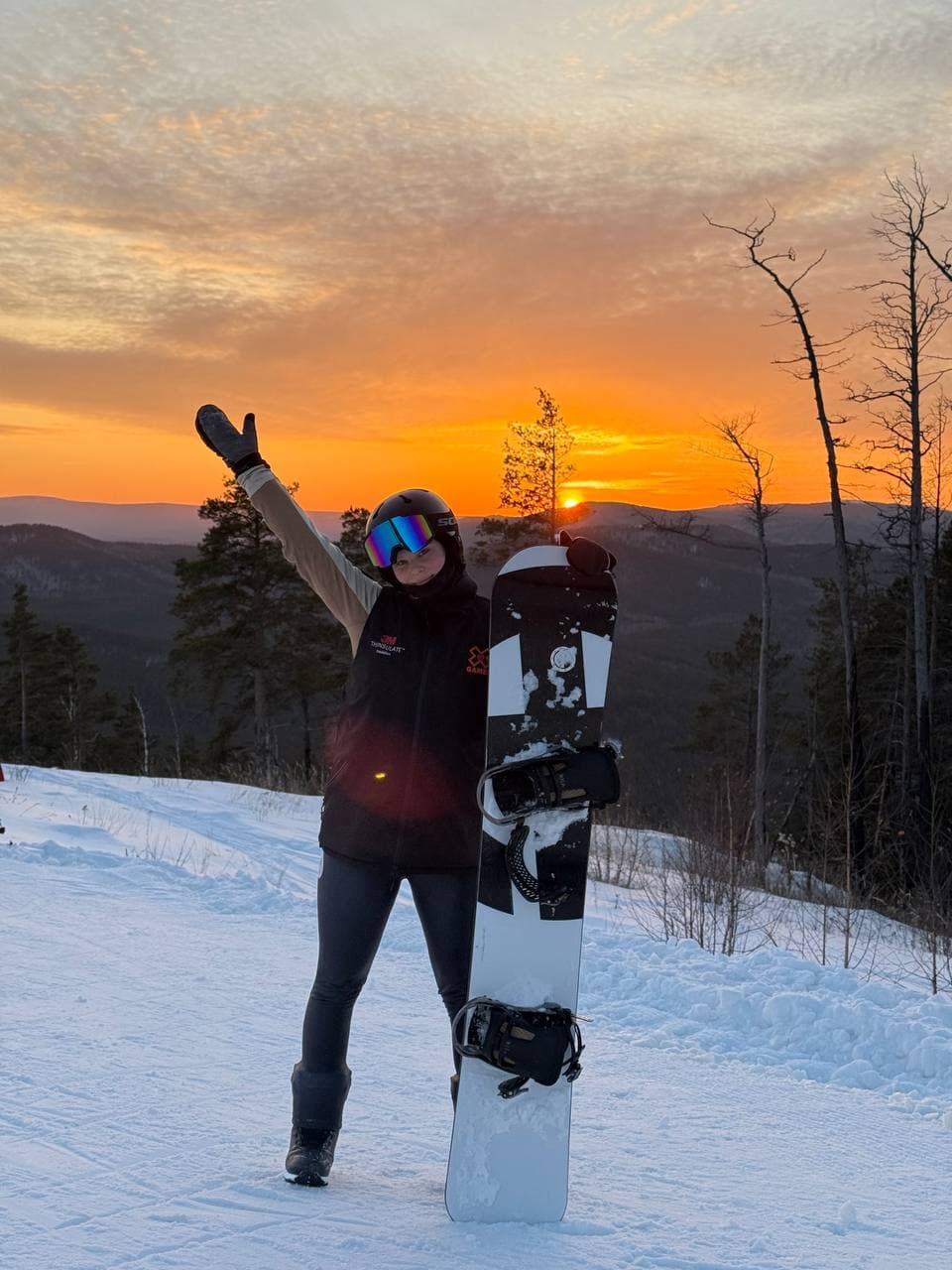
An interview with Sofia Mersadykova as part of the "Athletes and their experience" project.
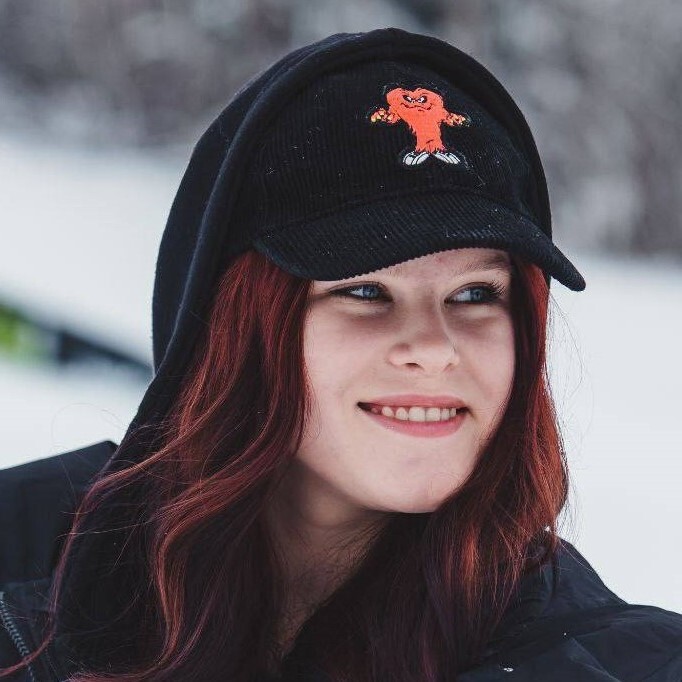
Sofia Mersadykova
Master of Sport of Russia in snowboarding, gold at the Finnish championship, several wins at the Russian junior championships, gold at the senior Russian championship and bronze at the first stage of the Russian Cup (snowboard cross).
Favourite trick in snowboardingThe frontflip — it was the first and only trick besides a horizontal spin that I managed to get out of myself when I was just starting freestyle.Music she can't train withoutI can't ride without music at all. My playlist is a wild soup, from Brazilian music to Yuri Vizbor and Alla Pugacheva. I'm very cyclical about music: if I'm in a good mood I can just loop Alla Pugacheva's "This World" and ride to it.A book or film that inspired her"Eddie the Eagle". A story she'll remember for the rest of her lifeWe were in France and I met a Canadian-French hippie snowboarder there. At the time I had a Nokia button phone with one song loaded onto it — "Du hast" by Rammstein — and no headphones, so it just played out of my pocket. He would catch me at the bottom by the lift and say: "Du hast!" Then we started going up together and somehow got talking in every language we had between us. Athletes have a tradition of swapping clothes, but we were very different sizes. I was about 12, he was definitely over 20. And the only thing we could swap was socks. I still have his black socks with the little weed leaf printed on them at home. The sweetest story.A motto or phrase that helps in difficult moments"Suffer long enough and something will come of it."
Sofia Mersadykova has been snowboarding for ten years. She started out in the sport as a multi-discipline athlete, competing in practically everything: freestyle (slopestyle, big air, halfpipe), parallel giant slalom and snowboard cross.
"When you're a multi-discipline athlete you pick up more skills than people who do just one event. Parallel giant slalom gives me a technical eye for turns and for the ways of taking them; my body understands how to turn so that it doesn't eat into my time. Freestyle adds survivability and agility, and coordination is much better overall. And cross, in effect, pulls all of that together. And adds speed and excitement."
Behind this young athlete lies gold at the Finnish championship, several wins at the Russian junior championships and the top prize at the senior Russian championship, won last season. But the path to that gold was a difficult one.
Sofia came to snowboarding at nine. Before that she had tried various sports, including cross-country skiing, but she wanted something different.
"I told my mum I wanted snow but not skis. And she had a former coursemate — Pavel Varnavsky, at the time a coach at a snowboard club in St Petersburg. And she took me round to his house. And said: 'Pasha, give us a board, we're going to Finland on holiday.' I jumped around Pasha's house on the board in the boots, and he said: 'That's my girl! We're taking her!'"
That was how the story of Sofia and snowboarding began. She rode a board with an instructor exactly once — on that same holiday in Finland. It made enough of an impression to leave no doubt.
"It was just so much fun… And you have to pick your stance too: left foot forward or right. I asked my mum which foot I should ride with — she pushed me off the slope with her foot, whichever way you go is the way you'll be — and that was that. And it was all so beautiful, so snowy, that I decided I wanted this."
After that she was coached exclusively by professionals: Pavel Varnavsky, founder of the FunBoardSchool snowboard club and future head coach of the St Petersburg snowboard team, and Serafima Rudakova, who among other things created an atmosphere of motherly warmth. The family feel of the club and the support of the coaching staff and the team helped Sofia enormously at the start of her sporting path. Her parents supported her too. Seeing their daughter's desire and potential, they made a difficult choice and moved her to home schooling.
"In about year five or six I was at school for a very small amount of time — out of nine school months I was there for a month in total. My marks were good, but that didn't suit my parents. And then they asked what I wanted, which direction, and I said I wanted sport, and they moved me to home schooling so that I could give a lot more time to it."
Sofia remembers her first competition win for life.
"I was pleased with myself, we had a mixed group with the boys, and there I stood, very pleased, first, the boys lost to me! What a star!"
And her first defeat too.
"The Spartakiad in Chelyabinsk in '22, it was the cross, I was first in qualifying, I'd prepared very hard for it, and in the finals everything went wrong. I ended up either sixth or seventh, and I cried about it for a very, very long time. A couple of hours, probably."
But elite sport is not only gruelling physical work. For Sofia the harder part turned out to be the intensity of emotion you have to handle before the start.
"There are mistakes I make regularly, in the same places, on the same features, something very cyclical. And most of the time I'm not nervous about the result itself but about a stupid mistake that could affect it."
Sofia has developed her own system for dealing with nerves. It has three stages. The first is strategic: visualize the course, picture the line through it, model the necessary sequence of actions step by step. The second is breathing practices and a technique for handling panic attacks.
"It's the rule of five: find one thing you can taste, two things you can smell, three you can touch, four things you can hold your eyes on, and five different things you can hear. You completely refocus onto something else, and your strength of spirit comes back to you."
And the third method is the simplest, but sometimes very effective too. Ignore the nerves.
"I detach completely, for example, distract myself, walk around, chat to someone, dancing, music, all that. And afterwards, once the race is completely over, I unpack all those emotions I held in for a while, and I'm like — oh, that was terrifying!"
Injuries brought even more trials. Predictably, about four years after she started, her knees began giving her trouble. For a long time the pain was put down to a growing child, growing bones and joints; there were even suspicions that Sofia simply didn't want to train. But it turned out to be more serious. Sofia had operations on both knees, and after recovering she came back to the slope. She is convinced that recovering physically was easier than getting her nervous system back in order.
"The mental side is definitely harder. I had a very long run of setbacks, injury after injury… Four years. And mentally the first two years were very, very hard. You're floating around at the bottom of the results, nobody knows who you are… you try, you train, and there's nothing to show for it."
A period of resignation set in, close to despair, when she competed on autopilot, didn't place well and got almost no enjoyment out of it. And after yet another injury and yet another course of treatment — this time her back gave out — Sofia decided to leave the sport. It is a good thing she didn't rush the decision.
I decided I wanted to ride out the season, just to remember why I love this sport. Just to get a feel for it again. And somehow I let it all go, decided just to enjoy it, spend time with the people I love, just do the thing I love not in order to achieve something but purely for the fun of it. And that lightness, when you've gone past despair and genuinely let go — it helped enormously.
The result — the dream and the best prize any junior can win: gold at the senior championship! Analysing why it worked, Sofia sees it clearly: it came down to her psychological state. Last January she managed to find that inner balance herself, more or less intuitively, without the help of a professional psychologist. But she is sure that in the off-season, help from specialists would do athletes nothing but good.
"I'd actually like to have that kind of practice one day. It's like the training process. In the off-season you learn to work with your head, with your emotions and fears, and going into the season you're already ready for whatever your head might pull."
For the coming season, which will be her last junior championship, Sofia again has a mostly psychological goal: to keep that lightness, to ride for the pleasure of it, remembering why she is here and what for.
"Not to start that battle for results again, because the more you focus on that, the more fear and tension and all the rest of it there is. And the goal would be to carry on in the same frame of mind: just to remember why I love this sport and keep remembering it."
The greatest victory is the victory over yourself, Sofia Mersadykova believes. And to anyone who is only dreaming of taking up snowboarding seriously, her advice is to go and take up snowboarding seriously — preferably at the St Petersburg sports club FunBoardSchool, the one she was lucky enough to find herself.
We sincerely wish Sofia good mental health, enjoyment of her snowboarding and many more wins!