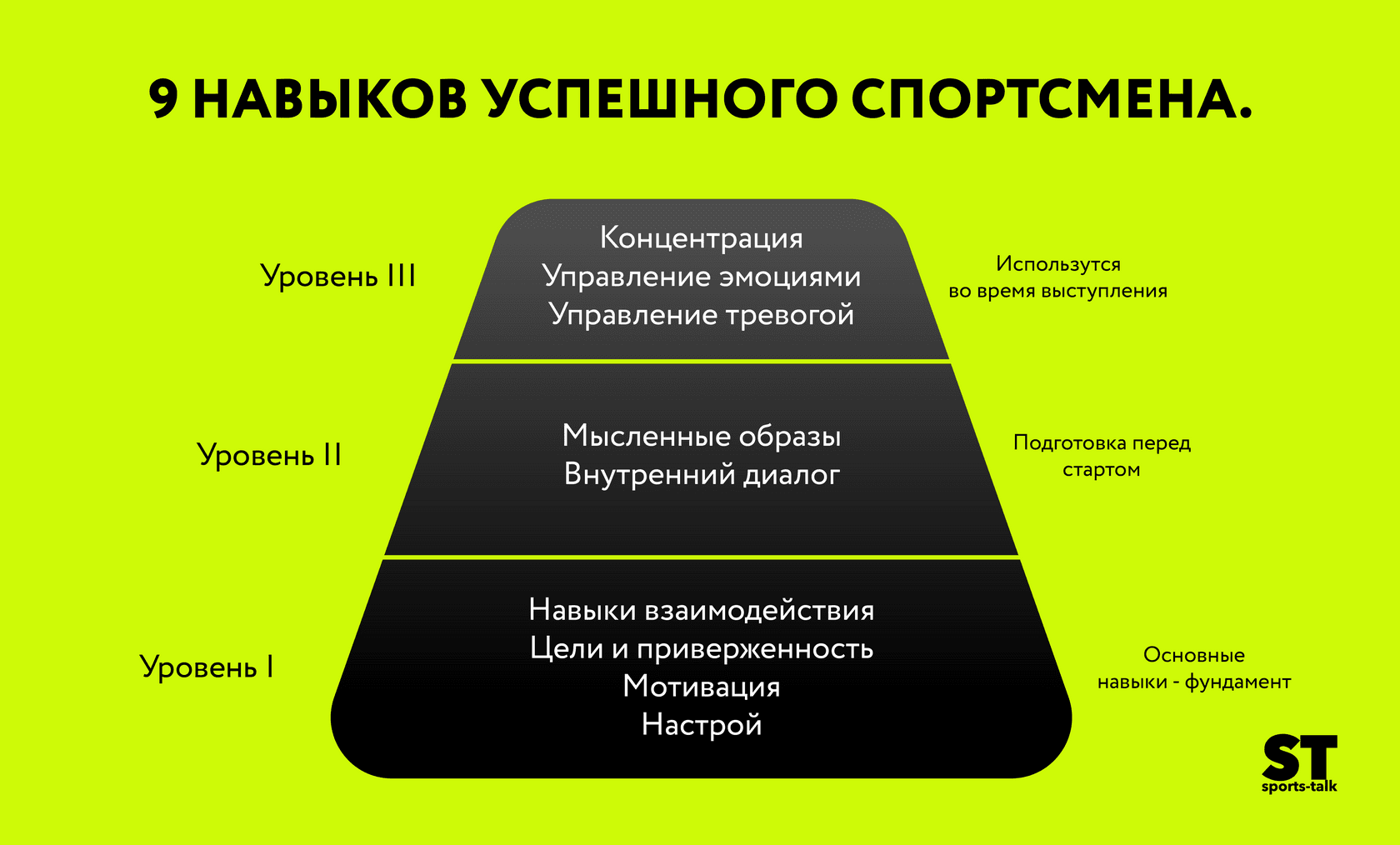
- A short list of the nine mental skills.
- The pyramid of mastery.
- A detailed description of the nine skills.
- Recorded webinar "Key skills of an athlete" (on another page)
To be a successful athlete you don't have to be a professional or an Olympic champion. You don't need a room full of trophies, a national title or a place on the front page of the sports news.
The people sport psychologists work with might include:
- an 11-year-old figure skater who hasn't yet won a single competition,
- a schoolboy golfer off scratch,
- a middle-aged woman whose goal is to run her first marathon,
- a weightlifter holding several world records,
- and an Olympic medallist.
What do all these athletes have in common?
- Their sport matters to them, and they are trying to become the best version of themselves within real constraints — time, work, family, money, natural ability.
- They set themselves high but realistic goals and train wholeheartedly.
- They are successful because they are moving toward their goals and enjoying their sport. Sport makes their life richer, and they are sure that what they put in is worth what they get back.
There are nine specific psychological skills that underpin success in sport. All of them can be learned and improved through practice. At Sports Talk we work with athletes of any age and any level, helping them learn and develop these key skills.
We think this matters, because the same psychological skills that help athletes get results in sport help in other areas of life too.
A short list of the nine mental skills
Successful athletes:
- Choose and maintain a positive attitude.
- Sustain a high level of self-motivation.
- Set high but realistic goals.
- Deal effectively with people.
- Use positive self-talk.
- Use positive mental imagery (visualization).
- Manage anxiety effectively.
- Manage their emotions effectively.
- Maintain concentration.
Training the mental skills
These nine skills matter in sport and in any other situation that calls for effective performance.
At the Ohio Center for Sport Psychology we:
- believe these skills can be developed through instruction and regular practice;
- begin by assessing your current level in each skill;
- build an individual plan for developing the skills that need improvement;
- reassess periodically to track progress.
The pyramid of mastery.
Each of the nine skills matters, but their key role appears at different phases of preparation and performance.
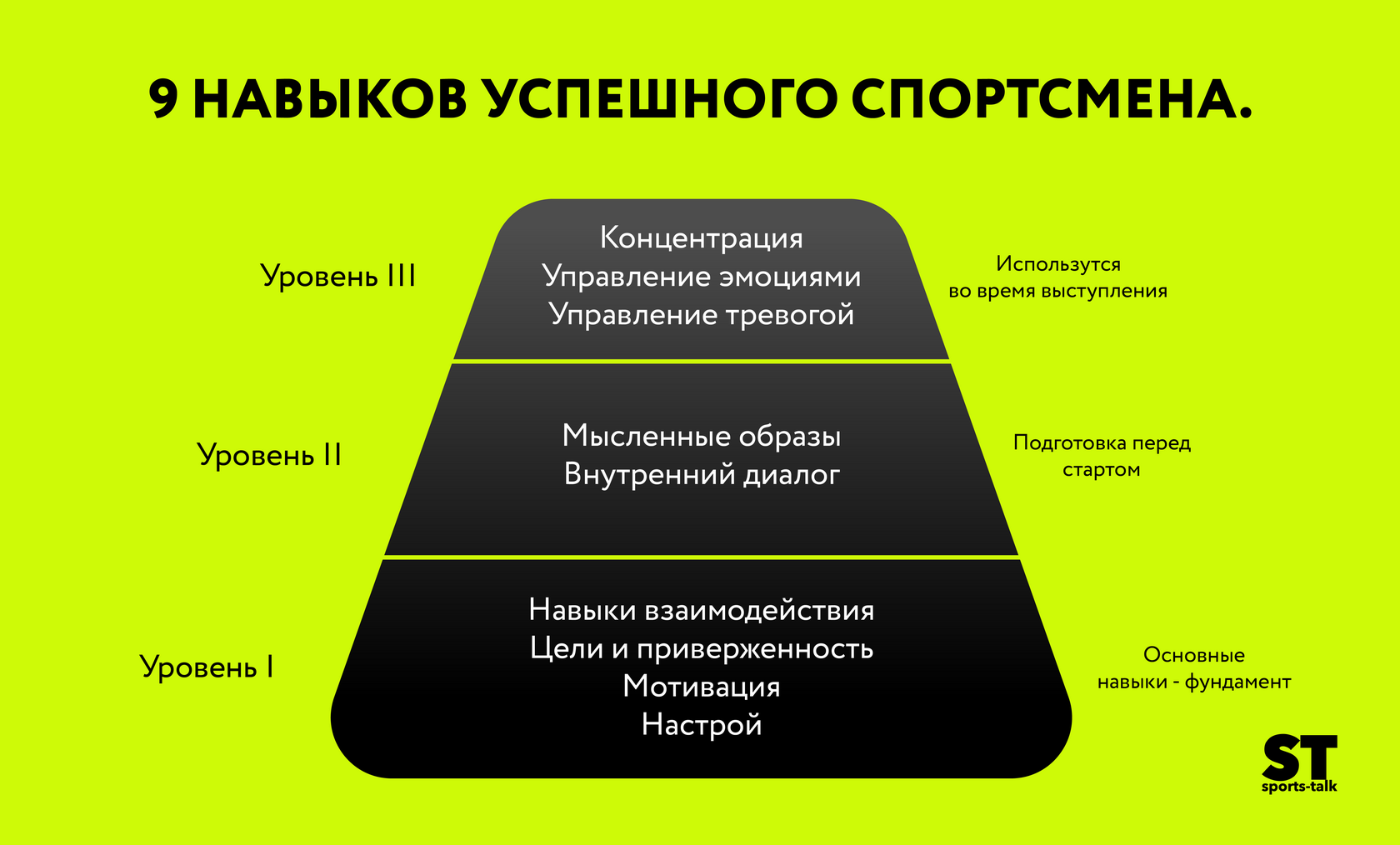
Level I
Skills that create the foundation for long-term development, consistent practice and progress toward big goals. These skills are used daily, over months and years.
Level II
Skills applied immediately before performing — before a start, a golf shot, a free throw in basketball and so on.
Level III
Skills that come into play during the performance itself.
Each level is built on the one below: the stronger the base, the more effective the work during preparation and competition.
A detailed description of the nine skills.
1. Attitude
Successful athletes:
- understand that attitude is a choice;
- choose a predominantly positive view of their sport;
- see sport as a chance to compete with themselves and to learn from wins and mistakes;
- pursue excellence rather than perfection, understanding that neither they nor their coaches nor the officials are perfect;
- keep a balance between sport and the rest of life;
- respect the sport, their opponents, their coaches, the officials and themselves.
2. Motivation
Successful athletes:
- know what values and rewards they get from their sport;
- are able to get through difficult periods, even when the results are not immediately visible;
- understand that most of the benefits come from taking part, not only from the result.
3. Goals & Commitment
Successful athletes:
- set long-term and short-term goals that are realistic, measurable and time-bound;
- know their current level and make specific plans for improving;
- are highly motivated to meet the daily demands of the training process.
4. People Skills
Successful athletes:
- understand that they are part of a system: family, friends, team, coaches and others;
- can talk about their thoughts, feelings and needs, and can listen to others;
- have the skills to get out of conflicts and to deal with difficult opponents and people who behave negatively.
5. Self-Talk
Successful athletes:
- sustain their confidence with realistic, positive self-talk;
- talk to themselves the way they would talk to a best friend;
- use self-talk to manage their thoughts, emotions and actions during competition.
6. Mental Imagery
Successful athletes:
- prepare for performances by picturing themselves succeeding in action;
- create detailed, realistic and specific images;
- use imagery during competition — before actions and after mistakes.
7. Managing Anxiety
Successful athletes:
- accept anxiety as part of sport;
- know that moderate anxiety helps performance;
- can bring anxiety down when there is too much of it, without losing their competitive edge.
8. Managing Emotions
Successful athletes:
- accept strong emotions — excitement, anger, disappointment — as part of the experience;
- can use emotion to improve their performance rather than damage it.
9. Concentration
Successful athletes:
- know what they need to pay attention to in each situation;
- can hold their focus and filter out external and internal distractions;
- can regain concentration quickly after a lapse;
- can play in the here and now, without their thoughts drifting into the past or the future.
Applying the nine skills beyond sport
The same skills work in all sorts of areas where there is a performance and responsibility for a result.
Signs of a situation that calls for performance skills:
- it is scheduled in advance;
- it has a beginning and an end;
- the rules and conditions are known;
- the result is judged against clear criteria;
- the outcome is not guaranteed and may involve psychological risk;
- the result matters to the person;
- the behaviour is directed at achieving a goal;
- success depends on the performer's skill.
Examples of such situations:
- an important job interview;
- a solo in an orchestra;
- a theatre audition;
- a school presentation;
- a driving test;
- speaking to the parents' committee;
- giving evidence in court;
- a medical board exam;
- performing brain surgery;
- landing an aircraft;
- firefighting;
- taking part in a special operation or a police assignment;
- landing a spacecraft on the Moon;
- climbing.
At Sports Talk we help everyone who wants to perform consistently at a high level develop these skills — in sport and beyond it.