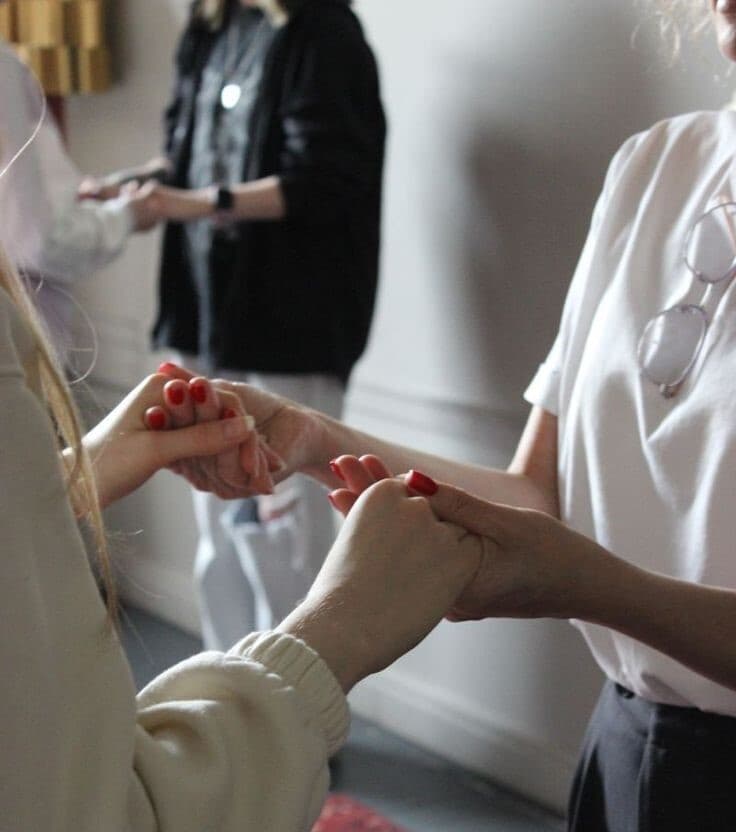
Psychotechnical games and exercises.
Play, as part of a child's healthy development, helps them loosen up and gradually deal with difficulties that seem insurmountable to them at the time (playing at competing, for example). Using psychotechnical games and exercises appropriate to the athletes' age satisfies their need to play and, at the same time, serves to activate and develop the relevant mental functions, to adjust their psychological state, and to build and maintain relationships within the group — while also being a means of pursuing a dual career.
"Psychotechnical games" sounds like "games not to be taken seriously", and points to a limited application — "in sport"; while "self-regulation" suggests the familiar, permitted forms — a kind of psychotherapy with a muzzle on.)
In fact these exercises were devised, tested, applied and described in a variety of settings: in psychotherapy with neurotic patients, in work with elite athletes, in personal growth groups — everywhere a good psychologist's foot could tread, and everywhere it was then thought it could not.
The book "PSYCHOTRAINING: GAMES AND EXERCISES" (by Nikolai Tszen and Yuri Pakhomov), on which this article is based, is full of episodes of practice, of the joy and discovery of meeting what is human in yourself, of a growing interest in our capacity simply to be — alone with ourselves and together with others.
Why play psychotechnical games with athletes?
Every coach feels the need to lift a young athlete after a poor performance, or to help them handle the nerves before a start, or to say something bracingly sharp that lets the athlete pull themselves together. Over long months and years of intensive work together, a coach inevitably finds an approach to each athlete. Day after day, working against the resistance of the "human material", the coach becomes more perceptive and wiser. He comes to know his students' minds and characters in fine detail. He knows who to say what to, and when. To get inside each of their inner lives he acquires a whole set of psychological keys and lockpicks.
In most cases the coach solves all the practical questions usually assigned to psychology perfectly well himself. He solves them better than a psychologist with a diploma would.
But a coach's intuition and experience are not all-powerful. And not every coach can boast of them. So alongside a masterly command of practical psychology, coaching also shows us the exact opposite.
Psychotechnical games and exercises are a universal psychological tool for a coach working with athletes of primary school, adolescent and youth age, because:
- Applied systematically, they can develop the core cognitive processes, the ability to self-regulate unhelpful mental states, and the building, maintenance and repair of relationships within a team or training group.
- They can reduce the subjective sense of fatigue and build and sustain athletes' motivation.
The game "Reflexion", for putting yourself in another person's place and mentally playing the situation out for them:
What will the exercise help with?
One of the fundamental mechanisms of mutual understanding is reflexion — the ability to put yourself in another person's place, to see and mentally play out the situation for them.
To win in modern sport is to confuse, to mislead, to catch someone on a feint, to leave them stranded with an unexpected move.
In elite sport, the ability to anticipate an opponent's intentions and disguise your own is one of an athlete's most important qualities. That is the view of many specialists in sport psychology, and most coaches and athletes would probably agree.
Reflexive contest, the crucial dimension in the psychology of a sporting duel, is familiar to everyone who competes. But it almost never becomes the subject of an athlete's deliberate training.
This game is for two.
How it works:
- You need a seven-square board and a counter
- The players sit opposite each other on either side of the board, with the counter placed on the centre square.
- On the facilitator's signal, or by themselves, the players begin to chant in unison: "SO—MO—…" The third syllable can be "…SCOOT" (the word "scooter") or "…PLANE" (the word "aeroplane").
- One participant's task is to match their partner — that is, to make their third syllable coincide with the other's.
- The other participant's task is to avoid being matched, to make the syllables differ.
- After each round the counter moves one square toward whoever won that round.
- The final win goes to whoever manages to pull the counter to their own end of the board.
- When explaining the rules, the facilitator draws the participants' attention to the fact that the third syllable must be spoken strictly simultaneously. Each must base their choice not on a sound that has already escaped their partner's lips — that would break the rules — but on an analysis of their partner's tactics.
Checking that the simultaneity rule is kept is very easy here, since the slightest hesitation by one player is picked up unerringly by the other.
The strength of "Reflexion" and games like it is that they let athletes acquire experience of reflexive contest quickly and in concentrated form.
Working with reflexive methods does not depend on the participants' physical endurance, which in principle allows you to train right at the edge of their psychological endurance. In this game the clashes of reflexion are fleeting and demand instant decisions.
During the exercise some participants experience psychological discomfort, connected with a constant sense that the decision just made is shaky, with the feeling of not being sure the move was right. Such people tend to lose at "Reflexion" more often than others, and generally to become lost in situations demanding instant judgements and decisions. In some cases this is connected with underdeveloped skills of reflexive calculation and, in particular, with an inability to stop calculating at the right moment.